Cloud · Visual Explainer
How Auto Scaling Actually Works
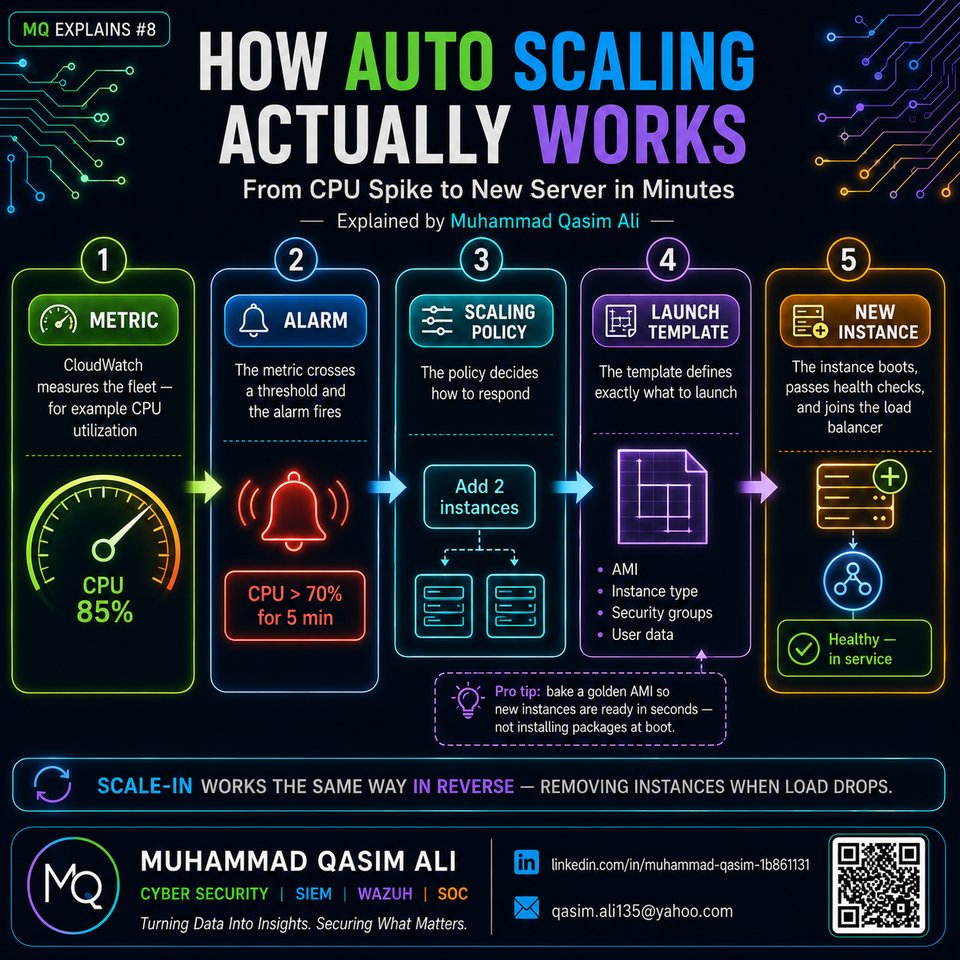
The concept
A chain of five links: CloudWatch measures a metric, an alarm fires when it crosses a threshold, a scaling policy decides the response, a launch template defines exactly what a new instance looks like, and the new instance boots, passes health checks, and joins the load balancer.
Key distinctions
| Term | What it means |
|---|---|
| Metric & alarm | CPU is the default but often the wrong choice — request count or queue depth track user pain more honestly. The alarm's duration is the debounce. |
| Scaling policy | Target tracking — 'keep CPU at 60%' — behaves like a thermostat and is the sensible default. |
| Launch template | AMI, instance type, security groups, user data. Bake a golden AMI so new instances serve in seconds, not ten fragile minutes. |
| Health & lifecycle | The instance must pass ELB health checks before receiving traffic; scale-in runs the chain in reverse with connection draining. |
Why it matters in practice
Break any link and 'auto' scaling silently stops being automatic. When an ASG scales out but users still see errors, the answer is always somewhere in this chain.