Security · Visual Explainer
IDS vs IPS vs SIEM vs XDR
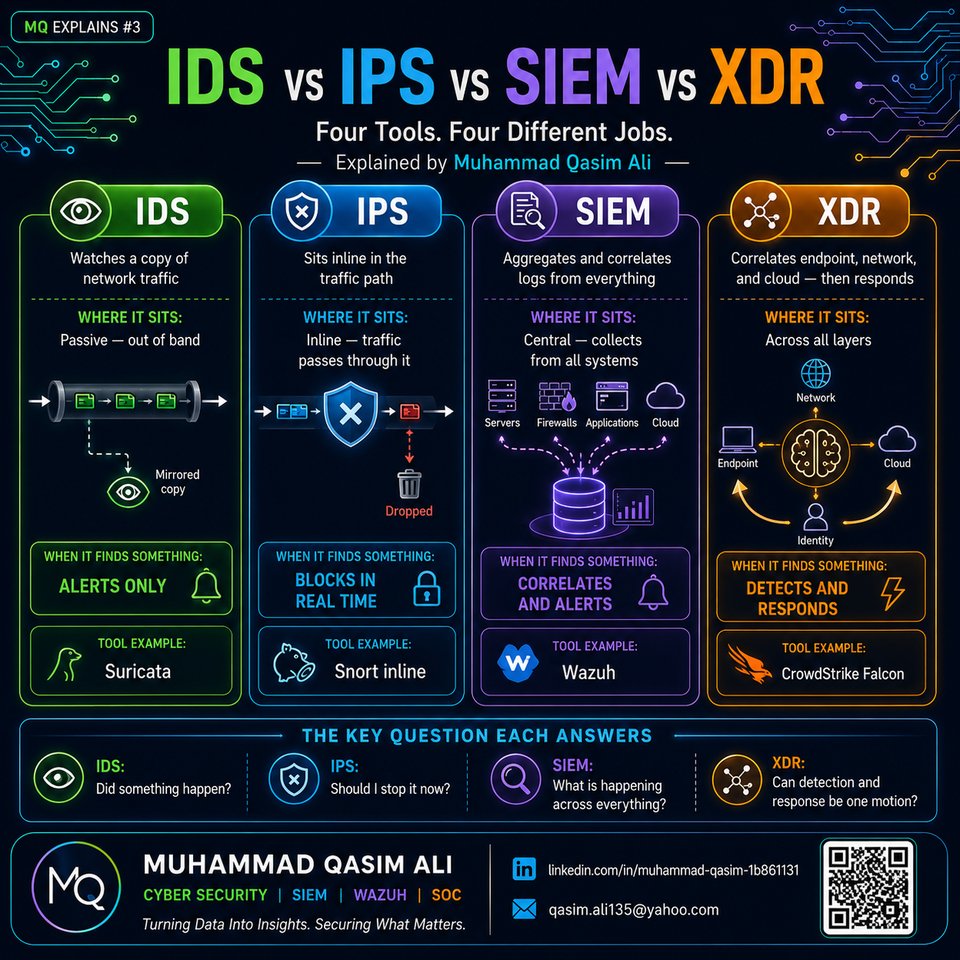
The concept
Four tools, four jobs. IDS watches a copy of traffic and alerts — passive. IPS sits inline and blocks in real time. SIEM aggregates logs from everything and correlates. XDR ties endpoint, network and cloud telemetry together and can respond automatically.
Key distinctions
| Term | What it means |
|---|---|
| IDS | Receives a mirrored copy of traffic. Zero latency impact, zero blocking power — a tripwire, not a wall. |
| IPS | Traffic physically transits it, so matching packets can be dropped. The cost of that power: a false positive blocks legitimate business. |
| SIEM | Breadth over depth — correlates across firewalls, servers, apps and cloud. Its unique trick is turning three boring events into one alarming story. |
| XDR | Vendor-integrated telemetry with response verbs — isolate the host, kill the process. Where SIEM says 'look at this', XDR can say 'handled it'. |
Why it matters in practice
They're layers, not competitors. A mature stack runs endpoint XDR feeding a SIEM, with inline IPS/WAF controls at the edge — each catching what the others structurally can't.