CI/CD · Visual Explainer
Anatomy of a Real Pipeline
The concept
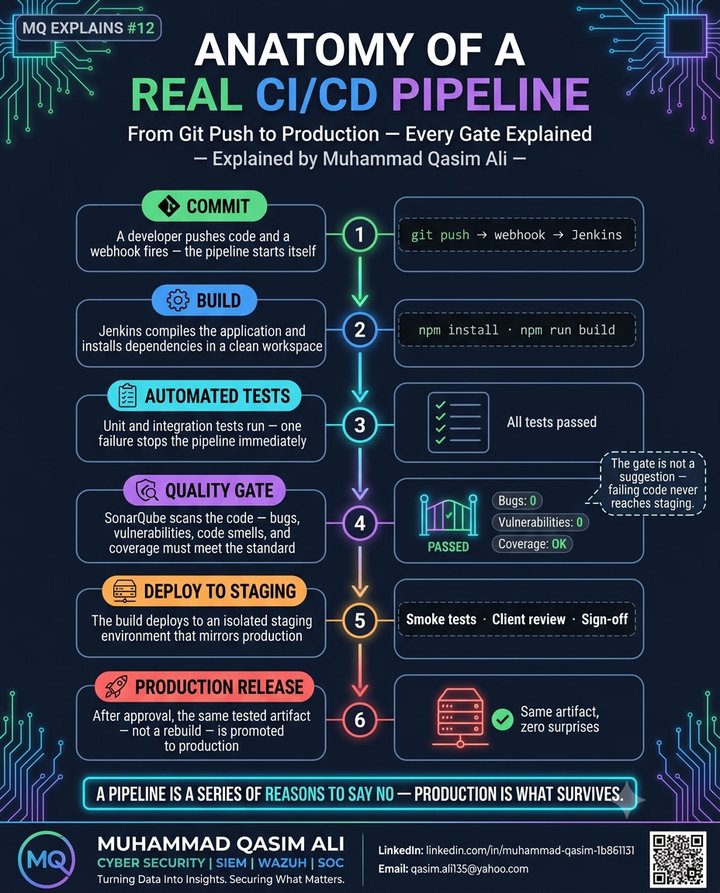
Six stages, each a reason to say no: commit fires a webhook; build compiles in a clean workspace; automated tests run and one failure stops everything; the quality gate checks bugs, vulnerabilities and coverage; staging mirrors production for sign-off; and production receives the same tested artifact — never a rebuild.
Key distinctions
| Term | What it means |
|---|---|
| Commit → build | A webhook starts the pipeline; a clean workspace with lockfile-exact dependencies builds it. Reproducibility is the point. |
| Tests as a wall | One red test stops the line. Flaky tests get fixed or quarantined loudly — never rerun until green. |
| Quality gate | SonarQube scans for bugs, vulnerabilities, code smells and coverage. Failing code never reaches staging. |
| Promote, don't rebuild | The artifact that passed testing is byte-for-byte what ships. Rebuilding 'the same code' invites dependency drift. |
Why it matters in practice
A pipeline is a series of reasons to say no — production is what survives. The 'same artifact, not a rebuild' detail is what separates people who've read about pipelines from people who've been burned by one.