Networking · Visual Explainer
Latency vs Throughput vs Bandwidth
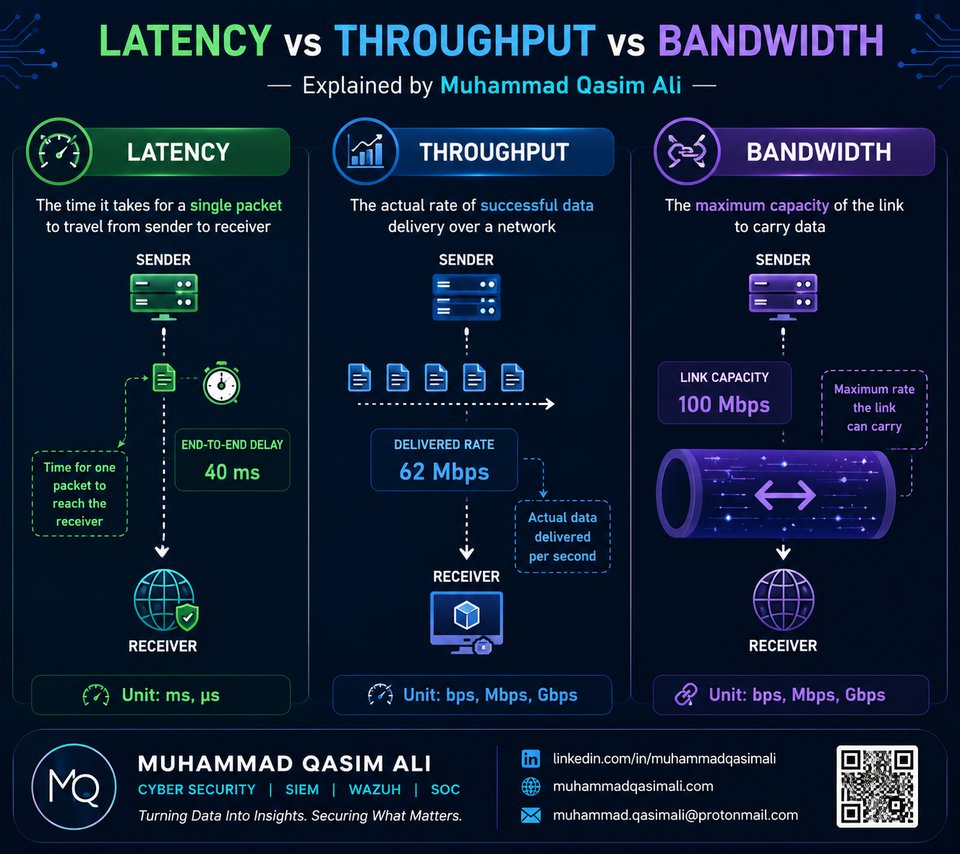
The concept
Bandwidth is the width of the pipe — the maximum it could carry. Throughput is what actually gets through after overhead and congestion. Latency is how long one packet takes to make the trip. A link can have huge bandwidth and terrible latency, or low latency and modest bandwidth.
Key distinctions
| Term | What it means |
|---|---|
| Bandwidth | A fixed property of the link — 100 Mbps means the link can move at most 100 megabits per second. It never changes with load. |
| Throughput | Measured reality — after protocol overhead, retransmissions and congestion, a 100 Mbps link might deliver 62 Mbps of useful data. |
| Latency | Round-trip delay driven by distance, hops, queuing and processing — measured in milliseconds, and bounded by the speed of light. |
| The trap | For small transfers latency dominates; for large transfers bandwidth dominates. A slow-loading webpage with 100 tiny resources is a latency problem, not a bandwidth one. |
Why it matters in practice
Most 'the internet is slow' tickets are actually latency, loss, or DNS — not bandwidth. Knowing which one you're looking at decides whether you add capacity, cache, or move content closer to the user.